-
-
- Standards Committee
- Advancement of the Professions Committee
- Audit and Risk Committee
- Education Committee
- Disciplinary Committee
- Charter Case Committee
- Preliminary Investigation Committee and Disciplinary Committee Liaison Committee
- Registration Committee
- Preliminary Investigation Committee
- Paper classification: some definitions
-
-
-
-
- About extra-mural studies (EMS)
- EMS requirements
- Information for vet students
- Information for EMS providers
- Information for vet schools
- Temporary EMS requirements
- Practice by students - regulations
- Health and safety on EMS placements
- EMS contacts and further guidance
- Extra-mural studies fit for the future
-
-
- Code of Professional Conduct for Veterinary Surgeons
- Code of Professional Conduct for Veterinary Nurses
- Contact the Advice Team
- XL Bully dog ban
- 'Under care' - guidance
- Advice on Schedule 3
- Controlled Drugs Guidance – A to Z
- Dealing with Difficult Situations webinar recordings
- FAQs – Common medicines pitfalls
- FAQs – Routine veterinary practice and clinical veterinary research
- FAQs – Advertising of practice names
- GDPR – RCVS information and Q&As
-
- Accrediting veterinary degrees
- Accrediting veterinary nursing qualifications
- Reasonable adjustments for student vets
- Health and disability in veterinary medicine study and practice
- The role of the veterinary schools and the RCVS
- Reasonable adjustments and the Equality Act 2010
- Reasonable adjustments and Day One Competences
- Examples of reasonable adjustments for vet students
- Annex
- Reasonable adjustments for student vets - summary
- Reasonable adjustments for student veterinary nurses
- Health and disability in veterinary nurse education and training
- Reasonable adjustments for students and the UK disability discrimination legislation
- Educational assessment of veterinary nurses
- Roles of key stakeholders in the application of reasonable adjustments
- Examples of reasonable adjustments for vet nurse students
- Embracing reasonable adjustments for student vet nurses - summary
- External review of the RCVS by ENQA
- Requirements for remote and online student assessments
Record number of overseas veterinary surgeons join the Register after passing RCVS Statutory Membership Exam
12 December 2025
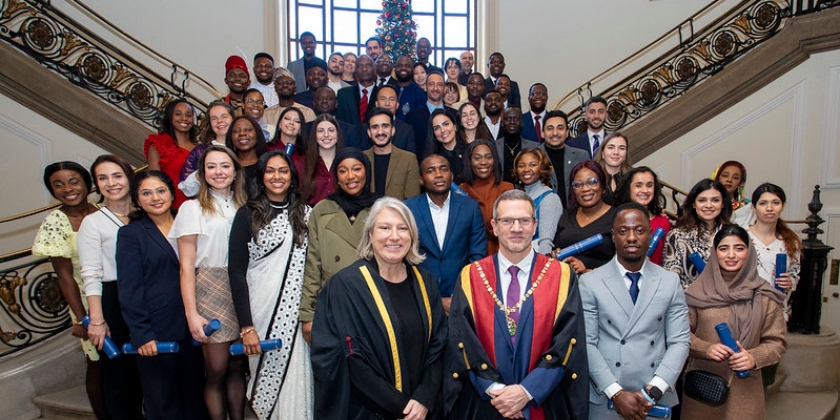
On Wednesday 3 December 2025, a record number of successful candidates for the RCVS Statutory Membership Examination were welcomed to the Register of Veterinary Surgeons in London, at a formal ceremony celebrating their achievements.
The Statutory Membership Examination needs to be undertaken by those overseas veterinary surgeons who hold veterinary degrees that are not recognised by the RCVS. The exam is made up of two components (each covering the three species domains of: companion animal; production animal and veterinary public health; and equine); a written theory exam, and a clinical, practical exam. Candidates must also have demonstrated their English language competence and professional good standing before being entered into the exam.
This year, a record 80 candidates passed the exam and are eligible to join the UK Register. Some 53 of these attended the ceremony, along with their friends and families, which was hosted by Clare Paget, RCVS Registrar and Director of Legal Services, and RCVS President Professor Tim Parkin at Central Hall, Westminster.
Speaking at the occasion Tim said: "Presiding at the Statutory Membership Exam Ceremony is one of the best jobs we get to do as Officers of the College, and I feel very fortunate to be able to share this special day with you and your friends and family at this magnificent venue.
"You should all be very proud of your achievements here today, especially as I know some of you came to the UK under difficult circumstances."
He added: "You should all be very proud of your achievements here today, especially as I know some of you came to the UK under difficult circumstances.
"The UK veterinary profession is very lucky indeed to have you joining it and I know that you will make a massive difference – you’ve already demonstrated amazing energy and drive, and you will also no doubt bring fresh and different perspectives with you - that, as I said, will only serve to enrich all of our lives."
After leading those in attendance through their professional declarations, Tim formally welcomed them as Members of the RCVS, able to practise veterinary surgery in the UK.
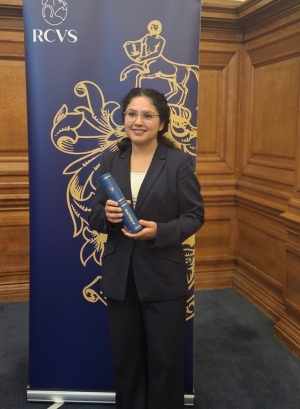 Among those who attended the day was Zahra Mohammedi (pictured right), who came to the UK after being forced to flee Afghanistan four years ago.
Speaking about the exam and her experience, Zahra said: "It wasn’t easy. When I first arrived in the UK, I still had the trauma from everything that had happened in my country. I struggled a lot because I’d never left my family before and when I arrived in the UK, I was alone.
“I’ve had a lot of support from many people to get me to where I am today, and I feel like one of the luckiest people to have all these wonderful people around me. There are millions of girls in Afghanistan who don’t have this opportunity. I never gave up because I didn’t want the Taliban to win. Now I feel like I’ve won and they’ve lost. I’ve proven that Afghan women are worthy to study and work and can do whatever they want.”
Also in attendance was Clement Farasi, from Zimbabwe. Speaking about his goals for the future, he said: “I wanted to come here to broaden my horizons and learn more. My passion is surgery and I would love to become an orthopaedic surgeon. The exam was difficult and it was a lot of work, but I managed to do well.”
For Sohail Idrees, from Pakistan, sitting the RCVS exam was something he had always wanted to achieve. He said: “Completing the exam was always a dream. When I was in Pakistan working as a veterinary surgeon I used to go on the RCVS website and say one day I’ll get there. I’ve always wanted to work in the UK as a veterinary surgeon, and I would like to thank Sonia Green and Chorley Vets for all their support throughout the exam process.
“I’ve already secured a job – working as a veterinary surgeon in Birmingham, but I plan to go for my advanced veterinary practitioner qualification, in soft tissue surgery and orthopaedics.”
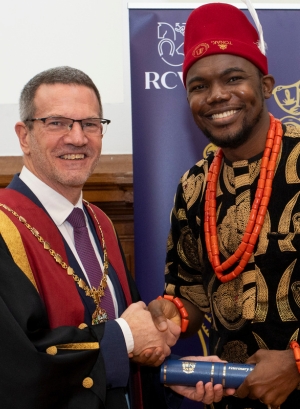 For Chibuzor Onyekwelu (pictured right with Tim Parkin), from Nigeria, becoming a vet has been a lifelong dream, and he wanted to sit the RCVS exam to help broaden his horizons. He said: “I dreamt of becoming a vet from the age of seven. When I qualified in 2016, I practised in Nigeria for five years but then I decided I wanted to work at a global level – I love a challenge and wanted to do something new.
“Having passed the RCVS exam I’ll now be able to work in Australia, New Zealand, South Africa, and Ireland so that one certificate will allow me to practise in four other countries.”
Chibuzor also added that the new Statutory Membership Examination rules, which came into place earlier this year, really helped support his progress. “Luckily, the new exam rules really helped me – I failed one of the domains initially and had to re-sit it but then passed. If it were still the old rules, I would have had to come back again next year to re-do the whole thing.”
Maryam Umar, from Nigeria, found a whole new passion throughout the process of preparing for the exam. She said: “The exam has given me a new perspective of veterinary medicine – I used to be all about small animal but in my time seeing practice I really fell in love with equine! I’m currently working as an Official Veterinarian (OV) auxiliary – I enjoy my job and want to climb the ladder as an OV as well as explore mixed practice.”
Further information about registration for overseas vets and which degrees are and aren’t recognised by the RCVS can be found on the Statutory Membership Examination section of our website.