The 2026 event featured 400 exhibitors and over 450 speakers across multiple theatres and showcases.
The RCVS had an exhibition stand where we highlighted recent work from across the College and colleagues also featured in a number of talks and panels across both days.
The exhibition stand provided delegates an opportunity to engage directly with RCVS staff and leadership from departments including education, research, veterinary nursing, and the Mind Matters Initiative. At the end of the first day, Tim Hutchinson, President of the RCVS, commented: “It’s been a fantastic day so far – we’ve been really busy. We’ve been showcasing areas like the RCVS Academy, which is a fantastic and useful resource for vets and nurses.
“We’ve had quite a few questions about implementing Competition and Markets Authority (CMA) remedies, and we expect to have a lot more conversations about these over the coming day.”

Talks and panels
On the first day, Dr Linda Prescott-Clements, Director of Education at the College, gave a talk on the development of a specialist training programme for general practice veterinary professionals. Linda provided delegates with insight into the curriculum and who the voluntary training programme is most suitable for. In addition to providing vets with greater clinical training and knowledge, the programme includes a wide range of professional skills modules and a research component.
Those successfully completing the programme would be eligible for RCVS Specialist status. Linda provides further insight into the training and the consultation on our first ‘In Focus’ podcast episode.
CEO Lizzie Lockett and Project Lead Catherine Hemingway were involved in a panel discussion surrounding the role of artificial intelligence (AI) in treatment and care. The talk explored veterinary professionals’ use of AI, as well as an update on the AI Transparency Alliance’s framework, which aims to provide the right information, in the right format, to support vets and nurses to make informed decisions about AI use.
The current framework, which was co-developed with Susie Samuel, CEO of Digital Practice, comprises two parts. The first is a list of 25 considerations for technology developers when producing AI tools for the veterinary professions, and the second part is a series of questions veterinary professionals should be asking of the AI provider to make sure they understand the tool and its role in care and treatment of their patients.
Angharad Belcher, Director of Advancement of the Professions at the College, also spoke about the Mind Matters Initiative’s work on suicide prevention in a talk titled ‘Protecting our profession: Implementing suicide prevention with confidence and care’.
The talk discussed the resources available, including the RCVS Practice Standard Scheme’s prevention toolkit, podcast and webinar, as well as practical steps and guidance on communicating suicide prevention safely in veterinary workplaces.
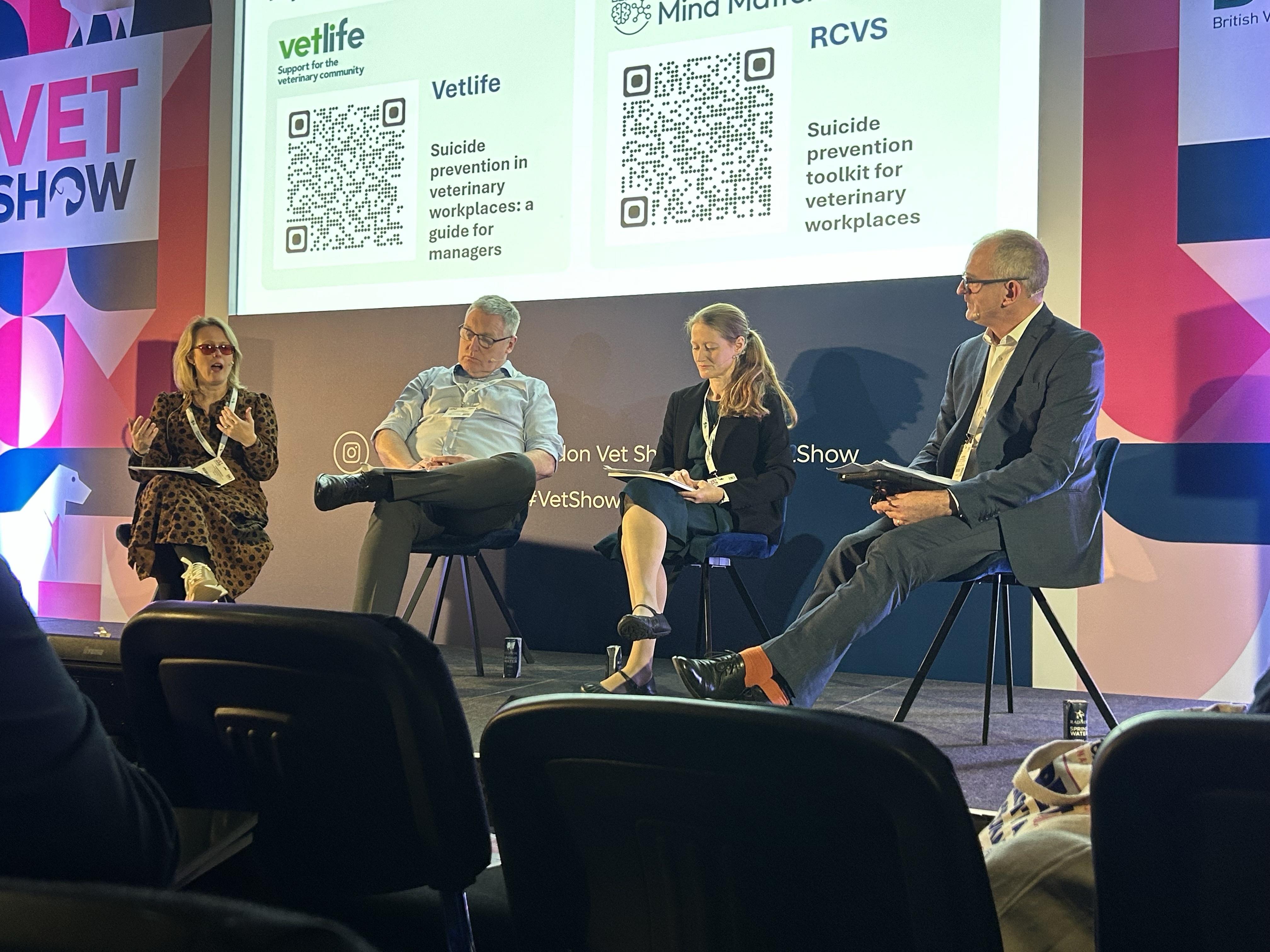
Angharad highlighted that the assessment of practice suicide prevention in PSS is not pass/fail, and that support can be provided through a systematic approach and by creating an environment where people feel comfortable asking for help. She added that effective prevention looks different from workplace to workplace, as each plan has to cater to its specific needs and characteristics of its practice. For more information, this topic was explored further in a recent episode of the RCVS Podcast.
At another talk, Vicki Bolton, Research Manager at the College, outlined the latest research on a possible vet nurse prescriber role. Currently, only a veterinary surgeon has the power to prescribe veterinary medications. In human medicine, nurses can take an extra qualification which allows them to prescribe, but this is not yet available to vet nurses. The research is an early step along the road to vet nurse prescribing.
Elsewhere, Jim Green, Director of Operations at the British Animal Rescue and Trauma Care Association (BARTA) gave a talk about the essentials of emergency call-outs and how to operate within the RCVS Code of Professional Conduct. The session also highlighted the collaboration between the RCVS Academy and BARTA on online courses, such as ‘Small animal veterinary responder’.
This area of veterinary care was also explored at BARTA’s ‘Animals in Emergencies’ summit, which took place at the RCVS offices in October.