

RCVS website wins public choice award in pan-European digital awards ceremony
The new RCVS website has been recognised for digital excellence in the Lovie Awards.
On Thursday 22 October, the British Animal Rescue and Trauma Care Association (BARTA) held the Animals in Emergencies summit at the RCVS office in London.
This summit aimed to strengthen the integration of animals and their owners within UK emergency planning and response by fostering discussion and collaboration among rescue services, veterinary professionals, and animal welfare experts and other agencies.
Established in 2012, BARTA aims to support emergency services and veterinary responders in aiding animals during emergencies by providing multidisciplinary training and direction and enabling strategic collaboration with key stakeholders on incident management.
The summit opened with remarks from David Barrett, Junior Vice President at the RCVS, who highlighted: “For many people, animals are not simply possessions. They are companions, family members, livelihoods and an essential part of their communities. We know that people's decisions during emergencies are often influenced by their concern for the animals in their care.
“And yet, despite the important work already taking place across many organisations, animals are not always fully integrated into emergency preparedness and response.”
The event continued with words from BARTA Director Jim Green and BARTA Non-Executive Director Steve Foye. Steve recalled an incident involving an old pet, Billy the dog, getting stuck in a pipe in a park and the fire services' uncertainty about what to do. Fortunately, the dog was able to get out of the pipe on its own – but not before civilians had attempted to intervene first.
Jim explained that despite the UK Fire and Rescue Service Operational Guidance 2017 highlighting the impact animals can have on emergencies, there is still inadequate doctrine to effectively protect the welfare of animals, pets and pet owners.
Jim commented:
While human safety remains paramount, the reality is that the way society prepares for supporting animals in a crisis has a direct bearing on the safety, cooperativeness and mental wellbeing of people who are also affected, whether custodians or emergency responders.
Group workshop
A group workshop followed, led by Dr Poppy Ellis Logan, a scientist from King’s College London. Dr Ellis Logan is funded by the National Institute for Health and Care Research (NIHR). She studies how people think, feel, and make decisions.
Poppy is currently developing a research proposal focused on using the psychology of how people behave (behavioural science) to improve emergency planning for companion and assistant animal owners. She explained that discussions among the multidisciplinary attendees would help steer the direction of this research proposal.
First, Poppy presented some unpublished data about the baseline preparedness of animal owners amongst the UK public. Poppy had used survey data to estimate what percentage of the UK adult population owned animals, and how prepared they would be to manage their animals in different types of emergencies. For example, whether they had emergency supplies of food, water and medication, and how easy they would find it to evacuate with their animals.
After the introduction, the attendees formed four groups. Each group had attendees from a range of different agencies (emergency response, local government, veterinary sector, etc.) and also featured a note-taker reporting to Poppy. Each group discussed how their agencies might be involved or affected by one of the following two scenarios:
The groups that discussed the dirty bomb scenario explained that it could be difficult to evacuate and then decontaminate such a dense area with a high footfall of people.
There were concerns about the need to decontaminate both humans and animals together, and how this would work. Some animals may be more amenable to being decontaminated than others. Furthermore, vet practices are unlikely to be set up to accommodate unexpected decontamination requests.
Regarding current national, local and public preparedness, the groups expressed that there are alarming gaps. There was little confidence that animals and the concerns of their owners would be appropriately accommodated in the ‘official’ response; vet practices and veterinary hospitals would be at significant risk of being overwhelmed.
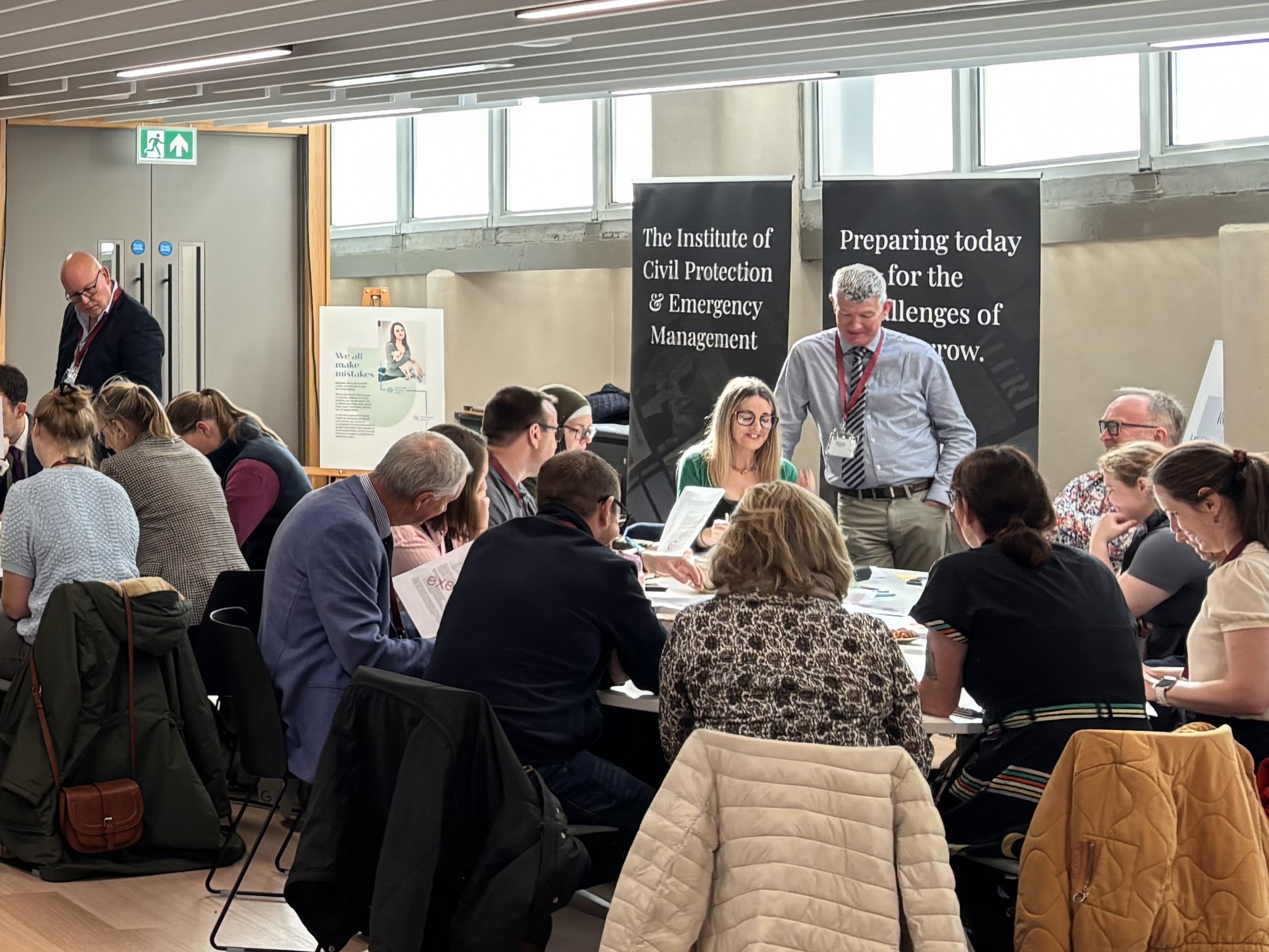
Moving on to the wildfire scenario, the allocated groups turned their attention to public preparedness. This type of emergency would likely require an individual to move their animals by themselves; while this may be easier for those with one or two small pets, it is not clear what support is available for those who would struggle, or what people who care for a large number of animals or livestock would do.
The groups emphasised the need for long-term support during wildfires. Evacuation orders could last for days, residences can be destroyed, and pet owners can be cut off from vet practices and supermarkets – these factors can all negatively affect the welfare of animals and their owners if not addressed.
All of the groups highlighted the need for clear and timely communication from institutions and organisations to ensure a consistent message between responders and other agencies during emergencies. They emphasised this would help limit the impact of misinformation.
Closing remarks and further work
The event closed with comments from Dr Danny Chambers, MP for Winchester, who highlighted that preparedness is key in these types of situations. As animal welfare in an emergency covers multiple ministerial groups (health, livestock, environment, etc.), a clear contingency plan that puts considerable attention on the topic is required.
BARTA, in collaboration with the RCVS Fellowship, is also launching two courses on the themes of the summit: ‘Small Animal Veterinary Responder’, which will be hosted on the RCVS Academy and ‘Smoke Inhalation’, which will be hosted on the BARTA website.
RCVS Fellows will also have a chance to speak to BARTA at this year’s Fellowship Day on 26 November, as they will have a stand at the event.


