-
-
- Advancement of the Professions Committee
- Standards Committee
- Audit and Risk Committee
- Education Committee
- Disciplinary Committee
- Charter Case Committee
- Preliminary Investigation Committee and Disciplinary Committee Liaison Committee
- Registration Committee
- Preliminary Investigation Committee
- Paper classification: some definitions
-
-
-
-
- About extra-mural studies (EMS)
- EMS requirements
- Information for vet students
- Information for EMS providers
- Information for vet schools
- Temporary EMS requirements
- Practice by students - regulations
- Health and safety on EMS placements
- EMS contacts and further guidance
- Extra-mural studies fit for the future
-
-
- Code of Professional Conduct for Veterinary Surgeons
- Code of Professional Conduct for Veterinary Nurses
- Contact the Advice Team
- XL Bully dog ban
- 'Under care' - guidance
- Advice on Schedule 3
- Controlled Drugs Guidance – A to Z
- Dealing with Difficult Situations webinar recordings
- FAQs – Common medicines pitfalls
- FAQs – Routine veterinary practice and clinical veterinary research
- FAQs – Advertising of practice names
- GDPR – RCVS information and Q&As
-
- Accrediting veterinary degrees
- Accrediting veterinary nursing qualifications
- Reasonable adjustments for student vets
- Health and disability in veterinary medicine study and practice
- The role of the veterinary schools and the RCVS
- Reasonable adjustments and the Equality Act 2010
- Reasonable adjustments and Day One Competences
- Examples of reasonable adjustments for vet students
- Annex
- Reasonable adjustments for student vets - summary
- Reasonable adjustments for student veterinary nurses
- Health and disability in veterinary nurse education and training
- Reasonable adjustments for students and the UK disability discrimination legislation
- Educational assessment of veterinary nurses
- Roles of key stakeholders in the application of reasonable adjustments
- Examples of reasonable adjustments for vet nurse students
- Embracing reasonable adjustments for student vet nurses - summary
- External review of the RCVS by ENQA
- Requirements for remote and online student assessments
Inaugural international postgraduate veterinary education event hailed as a great success
27 November 2025
The inaugural International Postgraduate Veterinary Education (PGVE) Symposium, the first event of its kind to bring together educationalists, practitioners, employers and education providers from across medical and veterinary education, took place on 18 and 19 November, with more than 140 delegates in attendance.
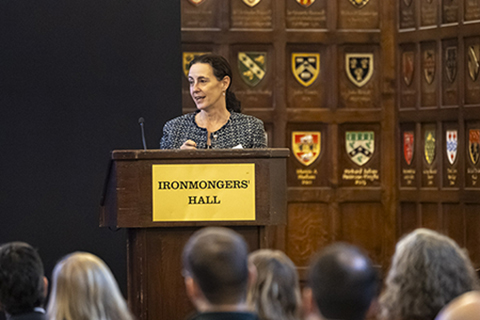 The two-day event was hosted by the RCVS at Ironmongers’ Hall in London with the aim of bringing together an international community of experts to develop collaborative approaches to postgraduate veterinary and veterinary nursing education, and to share examples of best practice across international and professional boundaries.
The four areas of focus for the days were: graduate transition into the profession; advanced education and training (eg postgraduate qualifications, internships and residencies); continuing education and professional development; and licensure and revalidation.
Accordingly, the event featured more than 40 presentations, including nine plenary speakers, who shared their expertise and insights into best practice and innovation in relation to PGVE.
Speakers shared the latest evidence in relation to topics including effective workplace-based assessment, feedback, professional identity formation, the use of Artificial Intelligence (AI) to support learning, challenges and advances in specialty training and (human) nurse education pathways, the use of Entrustable Professional Activities, limited licensure and licensure assessment for international veterinary graduates.
 Dr Linda Prescott-Clements (pictured) is RCVS Director of Education and co-chaired the event with RCVS Director of Veterinary Nursing Julie Dugmore RVN. She said: “We have received an unprecedented number of messages from delegates saying how much they enjoyed the PGVE Symposium and how useful it was, and we were delighted to see the many social media posts from delegates praising the event.
"The feedback we have received has been overwhelmingly positive and everyone is keen for a continued focus on this area and to develop the international community of veterinary educationalists further.
“I am grateful to all of our speakers from across medical and veterinary education who provided excellent plenaries and shared outstanding content for all the delegates. I am sure much was learned by everyone attending and there were certainly lots of useful and insightful discussions happening all throughout the event.
“It was also a truly international event with speakers from across Europe, Canada, the United States, Australia, New Zealand, South Africa and Hong Kong, so thank you to everyone who travelled so far to attend.
“The clear message from delegates was that this event needs to be the start of something bigger to promote and share PGVE research and best practice. We were very happy to get the ball rolling on this endeavour and we hope there will be many other similar events to come.”
For those who were unable to attend but wish to find out more, a full report of the proceedings will be published by the RCVS early in 2026. Videos of the talks and presentations will also be made available by the RCVS in due course.
To keep informed about the reports and recordings from the day, register your interest at our dedicated PGVE event webpage.