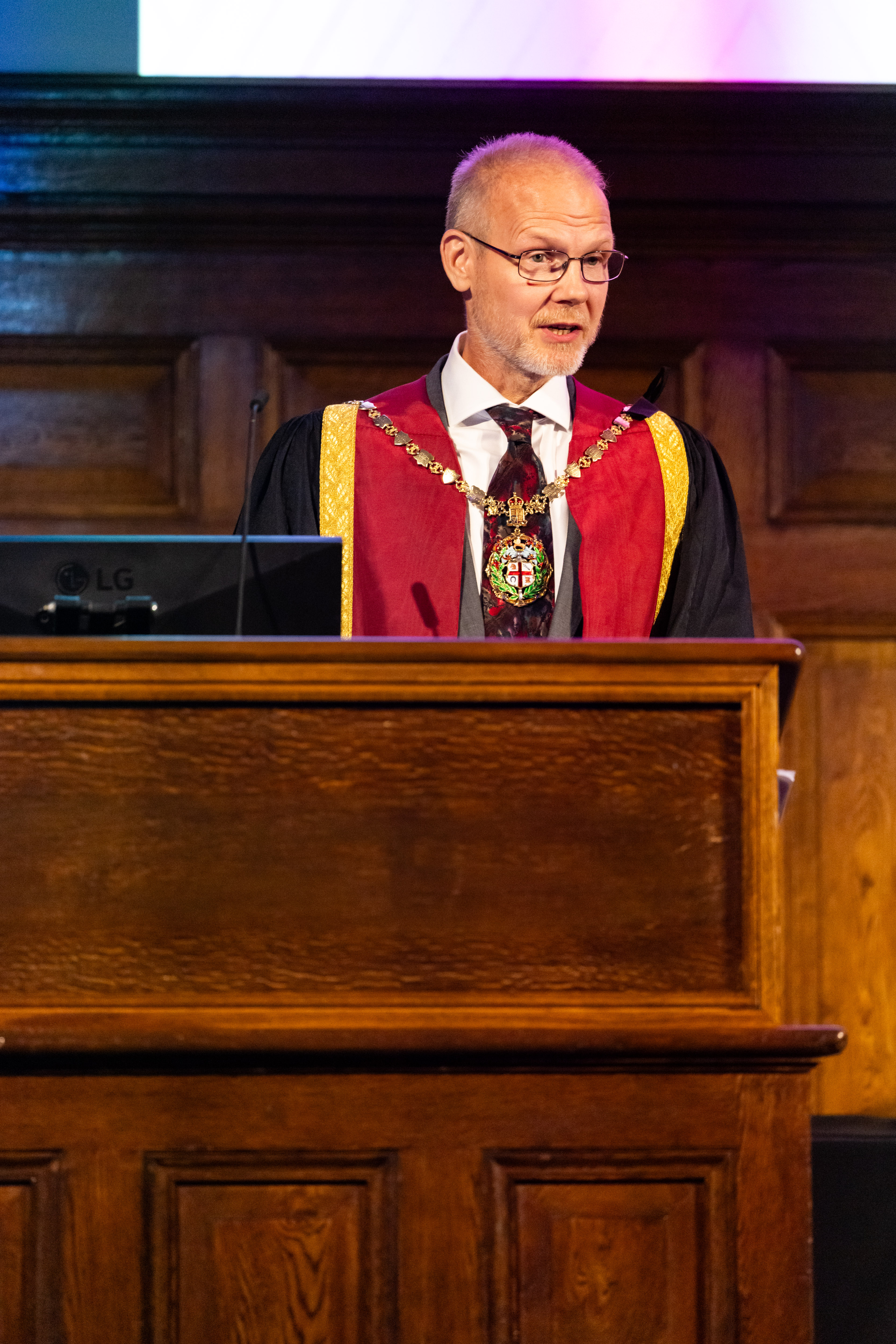
It is an honour to accept the responsibility of being President of our Royal College and I want to begin by thanking the entire College staff team who work tirelessly on our behalf. By setting us up to succeed in our roles as regulated professionals, everyone working at the College is doing their part to support the health and welfare of animals committed to our care.
It goes without saying that the current veterinary landscape is dominated by the CMA and VSA and I have spent much time reflecting on them both.
The American anthropologist and historian, Joseph Tainter, probably isn’t a household name to many here today, but might be best known for his 1988 work “The Collapse of Complex Societies”.
Tainter proposes that:
- As societies grow in size and sophistication, they create problems of complexity
- Solutions to these problems put an ongoing drain on resources,
- In turn there is a need for additional resource which necessitates further growth and complexity, and more resource-heavy solutions, until
- A society reaches a point where there is no more resource available to solve future problems of increasing complexity
- Gradual, but rapid, collapse ensues, which may be triggered either by
- growth reaching a natural tipping point of zero marginal return on investment of resource, or
- it may be accelerated by external factors that reduce available resource such that solutions that have already been put in place cannot be maintained.
Whilst Tainter focuses on large civilisations, the themes in his work are equally applicable on a smaller scale. For example, we could apply these principles to organisations like the NHS, which suffers from twin dilemmas of increasing complexity:
- Firstly, as we continue to research options for diagnosis and treatment of disease, this research leads to the development of increasingly complex solutions
- Secondly, there is a need to deliver this care to an increasingly complex population
Equally, we can look at veterinary care through Tainter’s lens:
- In common with human healthcare, we develop new ways of diagnosing and treating disease and enjoy the use of ground-breaking new therapeutics.
- Secondly, the businesses through which veterinary care is delivered face all the complexities of any other growing business, and the challenges of new legislation and bureaucracy which necessitate the creation of resource-sapping processes.
Do we risk a collapse of our complex veterinary society?
The resource which powers our professions comes from the discretional spend of pet owners, and the funds from those businesses which keep animals, such as farms and stables. It is finite!
The finite pool of resource which supports our profession becomes squeezed – and when the spending power of our client base is reduced by other societal factors then the situation is compounded by contraction of that finite resource.
I suspect that this was one of the triggers for the CMA investigation: some veterinary care has become much more sophisticated and complex. In Tainter’s terms it has become resource-heavy and exposed a disconnect between what a pet-owning public wants for their pets and what, collectively, it can afford to spend. How well do we, as professionals, bridge that gap and match service delivery to realistic expectations?
Fortunately, the ability to address this lies within our reach. We recognise that, inevitably, there is a cost to progress and sophistication and as such, the simple law of economics means that not all diagnostic tools or therapeutic interventions can be available to all animals. And if we accept that the high costs of the most complex animal healthcare will not be affordable by all our clients, we by default recognise that we need to provide a range of approaches and treatments, so that we can match the most appropriate approach to the context of the animal and its owner.
As professionals, our role is to ensure that we find this right approach, always with animal health and welfare front of mind and to deliver whichever approach we take to the best of our abilities. What we do for each individual case might vary; the quality of how we do it shouldn’t.
If the ability to practise contextualised care is the solution to countering the increasing complexity such that we can avoid a Tainter-like collapse, it also comes with its own inherent challenges for professionals and the practices in which we work.
Developing the art of contextualised care requires years of experience. For recent graduates, the juxtaposition of the demands for contextualisation with the completely understandable clinical naivety can lead to stress for clinicians. Consequently, the solution to a sustainable future for our profession lies in ensuring that the wisdom of experience can be passed down the generations with kindness and support.
And given that so much of the art of contextualised care revolves around human factors, specifically communication, we can help by ensuring that all professionals feel empowered to give themselves the permission to recognise that focusing CPD on elements such as communication skills are equally, if not more valuable, than learning more clinical material.
As regards our practices and the businesses which own them, there are different challenges. Employers must recognise the demands on professionals and create a supportive environment in which contextual experience can be developed, whilst still being able to balance the books of a business with a scale of charges that enable contextualised care to be practised.
There is also the need to consider investments into facilities and equipment. How often do we fall prey to the fear of missing out: practice X has invested in a new piece of kit, so we want one too, instead of looking at the needs of our client base and whether they want us to have that fancy piece of kit and are willing to fund it. Perhaps, instead, we could collaborate with other practices and find ways of supporting large capital investments so that the costs are offset by a collectively larger client-base?
Embarking on my year as President of the College affords me a platform and the opportunity to make three requests of our professions:
- Embrace the art of contextualised care to show that we have heeded the warnings of the CMA and avoid falling into a Tainter spiral of collapse
- Use our experience to support the development of others to enable them to practise in a contextualised way, with confidence, dispelling the fear of self-doubt
- Find ways to work collaboratively that deliver economies of scale
The Veterinary Surgeons Act, whilst outdated and in dire need of reform, talks about professionals practising the art and science of veterinary surgery. The science is exciting, but sustainability lies in perfecting the art.